
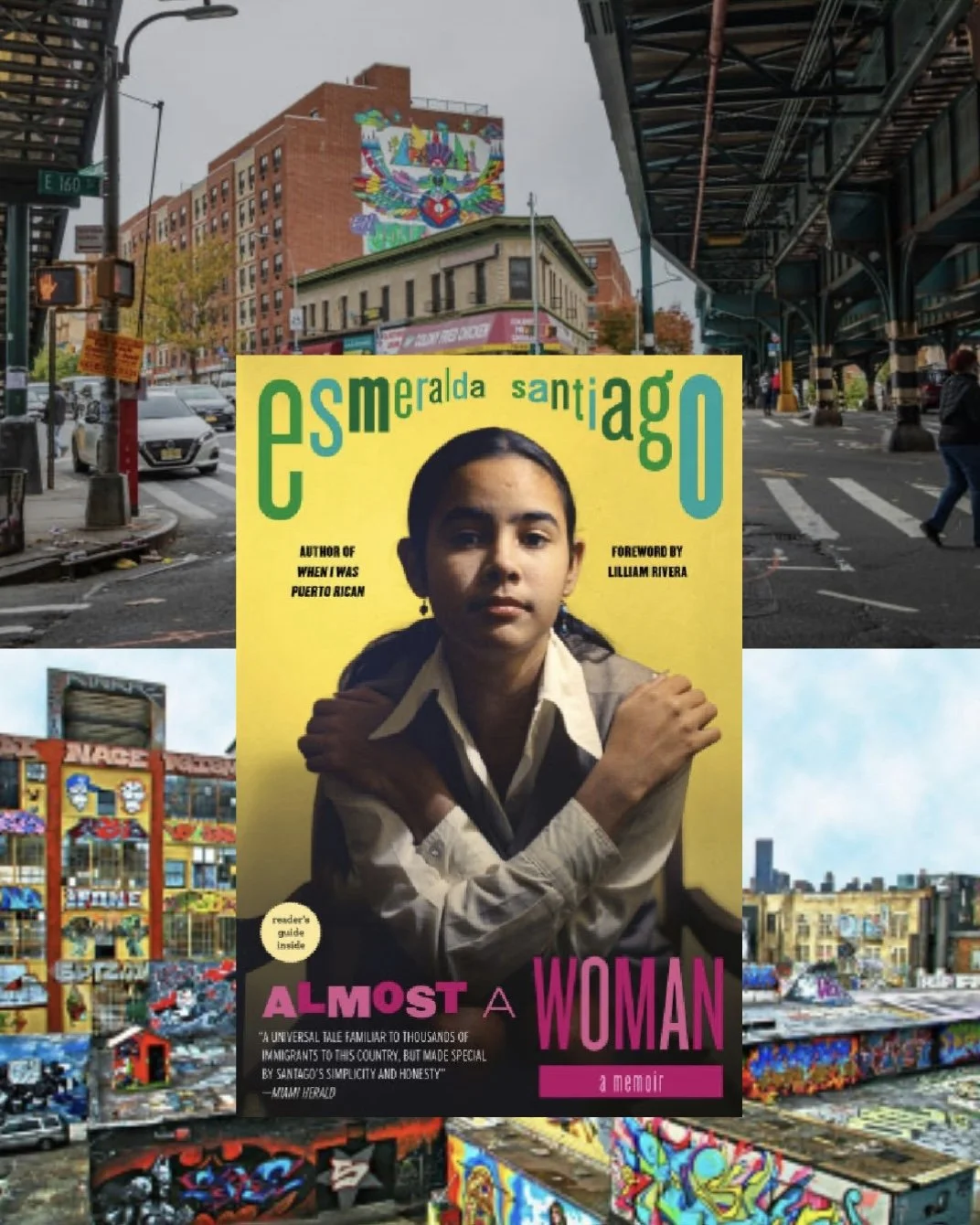
Esmeralda Santiago’s Almost a Woman: Art, Identity, and New York
“¿Tú eres hispana?” she asked.
“No, I’m Puerto Rican.”
“Same thing. Puerto Rican, Hispanic. That’s what we are here.”
When I finished Esmeralda Santiago’s first memoir and wrote about it in my blog post, “When I Was Puerto Rican: A New Identity,” what I most looked forward to in reading the sequel, Almost a Woman, was learning how she became a writer. We don’t get that story, but we do experience Esmeralda, nicknamed Negi, as a working artist on her journey to winning acting/dancing gigs while balancing work, home, and romance/relationships. Almost a Woman picks up immediately where When I Was Puerto Rican left off. Esmeralda is thirteen years old, thrown into her new surroundings in Brooklyn, New York, in 1961, with her mother and seven, eventually ten, siblings. She takes us along her adolescence until just a few weeks short of her twenty-first birthday. Santiago had to split these early years into two books because otherwise When I Was Puerto Rican would’ve been too long. I understood the title of her first memoir even more when she meets a girl outside of her apartment building who asks her if she’s Hispanic, a word unfamiliar to Negi. Overall, I was impressed by this young girl, born and raised in Puerto Rico, as she learns a new language and culture in a big American city. I was even more delighted with our similarities growing up in a Latino household.
What I found fascinating was that living in a low-income bubble in New York was the same as living in a low-income bubble where I grew up in Reading, PA. My parents met and married in New York in 1988. They then had me a year later, and my sister three years after. We left New York when I was four, so I always wondered what our life would’ve been like if we had stayed. Reading Almost a Woman was a peek into that life, and it surprised me. As an adult, I learned that my parents went on Section 8 to rent our first apartment in Reading. For most of my life, only my dad worked because my mom had back problems. In 1999, when my mom had my youngest sister, we benefited from the WIC program. When Negi and her family leave Puerto Rico, they move into a small apartment in Brooklyn with her maternal grandmother; however, it’s Negi’s mom who financially supports them, working in clothing factories. I related so much to Negi talking about her family not doing activities that cost money; that’s why she and her siblings looked forward to la compra with Mami. One of the most nostalgic memories of my childhood was also going food shopping with my mom and sisters. Pushing the cart down the aisles and picking out our favorite cereals and snacks was a highlight.
“What I found fascinating was that living in a low-income bubble in New York was the same as living in a low-income bubble where I grew up in Reading, PA.”
Negi’s mom experiences layoffs and periods when she can’t work due to pregnancy. She relies on Negi as the eldest to translate for her at the welfare office. I was so moved by this young girl who, like her mom, had just moved to a new country with a new language, but had to serve as the mouthpiece for her family. It’s a lot of pressure on Negi’s shoulders to say the words right in English and obtain the help her family desperately needs. I know many friends who had to translate for their parents. I was never in that position because both my parents speak English. My dad came to the States when he was nineteen and learned the language in two years. Negi struggles speaking in the welfare office, but thankfully, her mother’s application is approved. I was in awe of Negi’s first trip to the Brooklyn Public Library. I was expecting to finally get the story of how she discovered that she wanted to be a writer. That was when I realized it was silly to expect that when this memoir still covers her younger years. Of course, before she can even think about writing books, she has to become acquainted with the language. She borrows children’s picture books and pores over them at home, studying the words with her siblings. Books and television become her teachers. She quickly becomes Americanized, much to Mami's chagrin.
One of my favorite parts in the memoir is learning that the Archie comic books are a portal for Negi to discover “another United States—the trim, horizontal suburbs of white Americans.” There are no Americans in her Brooklyn neighborhood, so meeting the white teenagers in Archie introduces her to the world of the haves and have-nots. She observes that “their existence revolved around their social life, while mine was defined by my obligations as a student and as the eldest sister.” Like almost any Latino household, Negi’s mother is strict and doesn’t let her wear make-up or revealing clothes. She also can’t date until she’s married, which is a hilarious statement. I can relate to the no make-up and dating rules. Growing up, it was my dad who was strict. But nothing makes Negi understand her circumstances more than attending Performing Arts High School in Manhattan to study acting, the first student ever in her junior high to be accepted. There, she sees what it means to be advantaged, an experience I discussed in an early blog post, “Anti-Confederate.” I had grown up attending school with kids of similar backgrounds and socioeconomic status. Attending high school with a majority of white kids was a different story. I saw the material things they had that we didn’t. Santiago writes, “I was keenly aware of being a poor kid in a school where many were rich. In Brooklyn, most of my classmates came from my neighborhood and lived in similar circumstances, but Performing Arts drew from all over the city.” The advantage of having money meant that most of her peers had access to resources she never would. Her high school also taught her an early, valuable lesson: it’ll take at least ten years after graduating to make a living from her art. I appreciated Negi’s struggle as she walks in her artistic path. After high school, she juggles community college, jobs, auditions, and musical theatre. When you don’t have things handed to you, you have to create your own luck.
One of the privileges of being the eldest of three in my family was witnessing our gradual progress from apartments to our first house, a row home, and finally, to the suburbs during my college years. It took time, but my parents were able to move us out of the inner city and into a cul-de-sac. Negi’s mom moves them from apartment to apartment about twenty times before finally settling into their first house near the end of the book. What’s so admirable about the immigrant experience is leaving everything you know to start over in a new place while overcoming so many barriers like poverty and racism. Despite her mother’s warnings that something could happen to her, Negi grows into an educated and driven young woman. I found her final moments in this story relatable, her narrative a universal experience. As the title implies, this memoir starts with Negi being almost a woman. It ends with a decision she must make that pushes her fully into womanhood.

Maria Molina is a writer of Puerto Rican and Ecuadorian descent living in Pennsylvania with her husband, Albert, and their son, Sebastian. She writes essays on pop culture, personal growth, and parenting a child with autism. Maria is the author of the novella All Souls’ Day and the short novel Bendito. She was featured in Autism Parenting Magazine.