
Why Guillermo del Toro’s Frankenstein Reinforced My Parenthood Reading of the Story
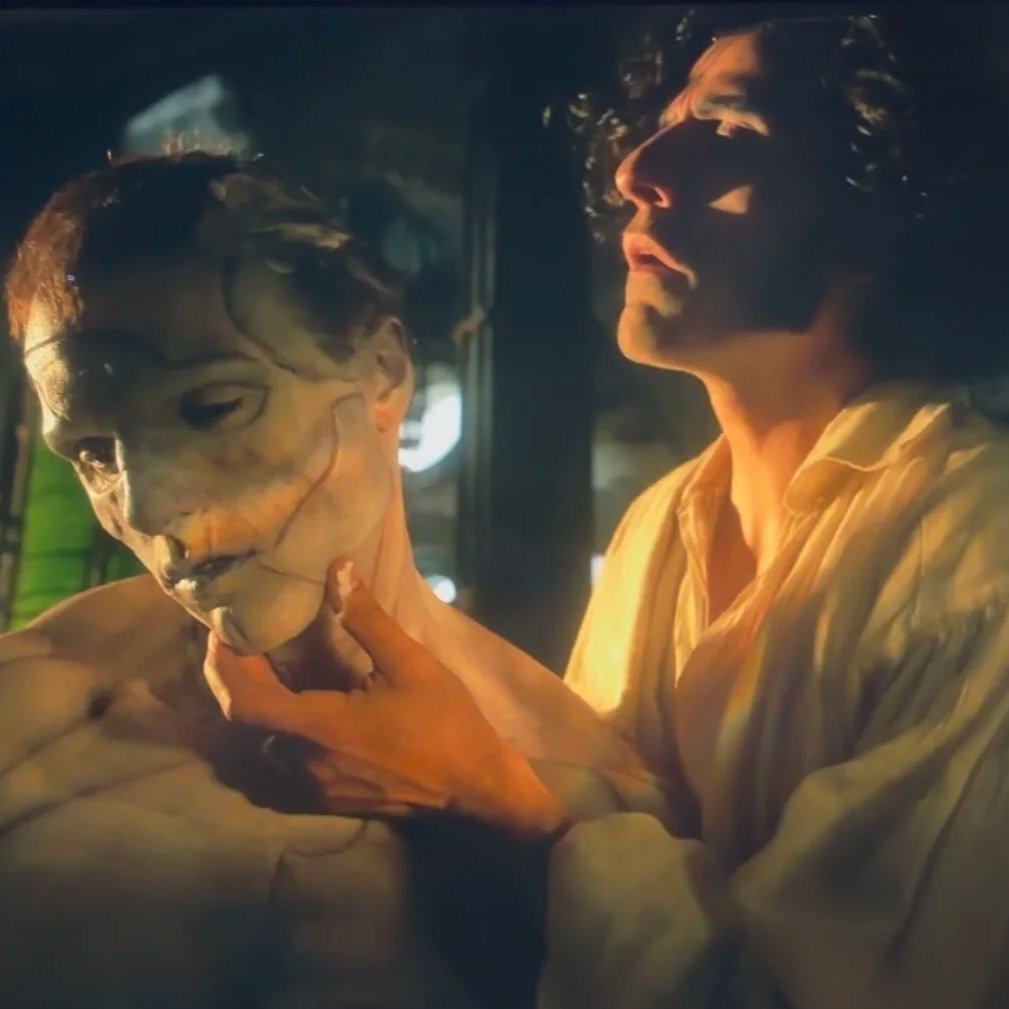
“I never considered what would come after creation.”
—Victor Frankenstein
“I am…the child of a charnel house. A wreckage. Assembled from refuse and the discarded dead. A monster.”
—the Creature
I first read Mary Shelley’s Frankenstein; or, The Modern Prometheus, during a semester in college when one of my favorite English professors covered the novel in class. It was in those collegiate years that I grew to love science fiction and Gothic literature, so Frankenstein was a perfect match. I empathized with the creature and his alienation. I understood it and infused that isolation and “monstrosity” in one of the characters of my first unpublished manuscript, which I titled The Broken and Gifted. I haven’t read Frankenstein in some time, but the ideas and themes have stayed with me. So much so that when I wrote my first self-published fiction in 2018, All Souls’ Day, I was hugely influenced by the mad scientist archetype that Shelley is credited with creating. I wanted a “mad scientist” character in my story, so I created Dr. Rene Rodriguez, a parapsychologist obsessed with proving that our consciousness doesn’t disappear when we die. He’s an ambitious man but a dreadful father who wishes his son would live full-time with his mother. Ironically, when I finished writing my novella, I pictured Oscar Isaac in the role of my mad scientist. Little did I know that Guillermo del Toro had wanted to adapt Shelley’s book his whole life, and he cast the perfect actor, Oscar Isaac, as the mad scientist, Victor Frankenstein.
I remember my professor telling us about an article in which the writer compared Victor’s reaction to his creature to a mother giving birth to a child with special needs—the disappointment and anger at not having their expectations met. I understood the example then, and now, having a son with autism who is non-verbal, it hits closer to home. I imagined sharing my love of reading and writing with my son. I wished to show him everything I knew about writing a story so that he could do it too and become an artist. Of course, it was disappointing coming to terms with our reality. For months, I was angry, sad, and anxious. I felt like I had failed and made some mistake. There’s also the regular first-time mother feelings that I wrote about in Workin’ Moms. That experience echoes Victor’s sentiment that he didn’t consider what comes after creation. I know I was a monster during that newborn stage, running on no sleep and little time for myself. Victor, too, loses sleep when the creature becomes alive. He has broken the boundaries of natural order and descends into madness, ultimately trying to destroy his “unnatural achievement,” as he comes to think of his creation. Victor’s also an example of how the creator can be a monster. Artists are often self-critical and berate their work as Mary Shelley did herself after writing Frankenstein, her first novel at nineteen.
In del Toro’s adaptation, Victor behaves like a frustrated father, utterly disappointed by what he believes is the creature's lack of intelligence. He’s impatient with his newborn as he tries to teach him and immediately keeps him shackled in the dungeon. His brother’s fiancée, Elizabeth Harlander, portrayed by Mia Goth, who also fittingly plays Victor’s mother, finds the creature in chains and reproaches Victor. What alarms her isn’t the creature’s existence; it’s Victor’s cruelty and indifference. Victor is annoyed that the creature doesn’t have the spark of intelligence he intended. “He only knows one word and just parrots it without rhyme or reason,” he tells Elizabeth. That single word is “Victor,” the name of his god. She angrily responds: “Perhaps for the time being, that word means everything to him.” As parents, we have a huge responsibility to our children because they have the resilience to love us no matter how badly we might treat them. But Victor doesn’t know how to be a parent and abandons him, leaving the creature to die. The creature, engineered to regenerate and possess eternal life, doesn’t perish in the fire Victor sets ablaze. He instead seeks his master, and on his journey, we see that the creature isn’t the monster at all.
The creature is tenderly brought to life by the Australian actor Jacob Elordi. I knew of him, but hadn’t seen anything he was in. After watching him in Frankenstein, I now look forward to the new adaptation of one of my other favorite Gothic novels, Wuthering Heights, where Jacob will play the brooding Heathcliff. I know Andrew Garfield was first attached to play the creature; however, I don’t think anyone could’ve been our creature but Jacob. First, there’s his height. He stands at six feet five inches, which is the perfect frame for the body Victor assembles from the large limbs of corpses he collects. Victor actually shrinks when the creature first appears at his bedside, showcasing his full intimidating stature. Jacob’s calm disposition seeps into the creature’s eyes and expressions; his dark eyes are a tranquil view into the creature’s soul, something Victor questions he even has. Lastly, there’s Jacob’s beauty. I wasn’t captivated by him until he became the creature. I think you needed a beautiful man to make us fall in love with del Toro’s new version of the monster. His innocence in taking in his surroundings like an infant helps us sympathize with him the way Elizabeth does. Their initial encounter is palpable. I loved the reference to Tarzan meeting another human, Jane, for the first time. Elizabeth’s curiosity is believable and is a glaring contrast to his maker’s. It’s one of the most beautiful scenes in an already aesthetically breathtaking film, from the sets to the clothing and the creature’s makeup.
Outside of the tower and in the real world, we’re witnesses to the creature’s kindness and purity. He befriends an old blind man and learns to speak by reading Milton and other works. Our journey with him is more peaceful than it was with Victor. While he only knows violence from Victor, the creature innately yearns for love. He wants to be part of a family and act as a benefactor and guardian. What’s more human than wanting to be loved? It’s telling that from Victor, he learns about violence, and with the blind man, he learns about forgiveness. This lesson is pivotal to the final scene between Victor and the creature when their separate narratives come to a close. At the start of the movie, the creature is shown as a monster, screaming in his guttural voice after an injured Victor, chasing him in the Farthermost North. Shipwrecked sailors rescue Victor and take him aboard their massive ship. In the closing scene, we’re back on the ship with the creature and Victor together in the captain’s cabin. Victor asks the creature for forgiveness and, finally taking on his fatherly duties, gives him his name. This is fitting because after so many adaptations of Shelley’s novel, the creature has come to be known as “Frankenstein.” The creature proves to be the better man, accepting the apology and leaving Victor. In a final act of kindness, he lifts the enormous ship, freeing it from the icy bank where it was lodged so the stranded sailors can finally sail home. I appreciated the film’s quiet ending with only the creature in the frame, basking in the breeze and sun. He can never die and is destined to be alone as his creator denied him a companion, but even so, he must go on. I imagine that he lives on as what the blind man once referred to him as—The Spirit of the Forest—anonymously committing acts of kindness. He might be broken, but he’s no monster.
Do you read Frankenstein as a story about creation or about what happens after creation, when love is tested? Leave a comment below!
Enjoyed this post? Subscribe below to get the next one straight to your inbox ✉️